
Throughout the liturgical year, the Catholic Church celebrates the saving mystery of Jesus Christ—from his Incarnation and birth to his Passion, Death, Resurrection, and the sending of the Holy Spirit. The liturgical year does not correspond exactly to the calendar year. It begins on the First Sunday of Advent and unfolds through six seasons: Advent, Christmas, Ordinary Time, Lent, the Sacred Paschal Triduum, and Easter.
At Sunday Mass, the Liturgy of the Word ordinarily includes a reading from the Old Testament, a Responsorial Psalm, a reading from the New Testament, and a Gospel reading. During Easter Time, the first reading is generally taken from the Acts of the Apostles rather than the Old Testament. Weekday Masses ordinarily include one reading, a Responsorial Psalm, and a Gospel reading.
The Sunday Scripture Cycle
The Sunday Gospel readings follow a three-year cycle:
Year A: Readings are drawn primarily from the Gospel of Matthew.
Year B: Readings are drawn primarily from the Gospel of Mark.
Year C: Readings are drawn primarily from the Gospel of Luke.
The Gospel of John is proclaimed throughout the Easter season and at other times when its readings are especially appropriate. The liturgical cycle changes with the First Sunday of Advent, not on January 1.
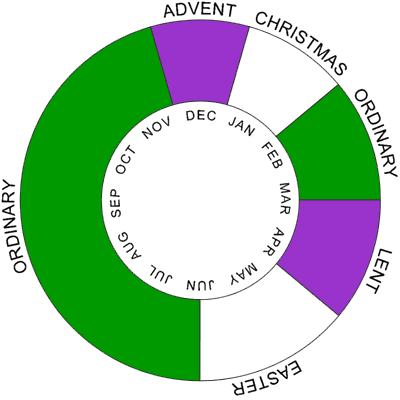
Season of Advent
Advent is a season of devout and joyful expectation. It prepares us to celebrate Christ’s birth at Christmas while also directing our hearts toward his return in glory at the end of time.
- Advent begins on the evening before the First Sunday of Advent and concludes before the celebration of Christmas begins on Christmas Eve. Because it always includes four Sundays, its length varies slightly from year to year.
- During the early weeks of Advent, the readings emphasize watchfulness, hope, and Christ’s Second Coming. Attention then turns to St. John the Baptist and his call to prepare the way of the Lord. From December 17 through December 24, the liturgy focuses more directly on the events leading to the birth of Jesus. These final days also include the ancient “O Antiphons,” which express the Church’s longing for the coming of the Messiah.
Season of Christmas
Christmas Time celebrates the Nativity of Jesus Christ and the mystery of the Incarnation—the Son of God becoming human for our salvation. The celebration extends beyond Christmas Day and continues through the Feast of the Baptism of the Lord.
- Christmas begins on the evening of December 24. The Roman Missal provides four different Masses for the celebration: the Vigil Mass, Mass during the Night, Mass at Dawn, and Mass during the Day.
- The first eight days of Christmas form the Christmas Octave, which concludes on January 1 with the Solemnity of Mary, the Holy Mother of God. The octave also includes the feasts of St. Stephen, St. John the Apostle and Evangelist, and the Holy Innocents, as well as the Feast of the Holy Family.
- The Christmas season also includes the Epiphany of the Lord, celebrating Christ’s manifestation to the nations. In the United States, Epiphany is ordinarily observed on the Sunday between January 2 and January 8. Christmas Time concludes with the Feast of the Baptism of the Lord.
Season of Ordinary Time – I (begins)
This liturgical season can also be called “Ordered Time” or the “Season of the Year” (when Sundays are sequentially numbered).
- The first period of Ordinary Time begins on the Monday following the Feast of the Baptism of the Lord and continues through the Tuesday before Ash Wednesday.
- The word “ordinary” does not mean that this season is unimportant. It refers to the ordered, or numbered, weeks during which the Church reflects on the life, teachings, miracles, and ministry of Jesus. Green is the principal liturgical color of Ordinary Time and symbolizes life, hope, and spiritual growth.
Season of Lent
Lent is a season of conversion and preparation for Easter. It has both penitential and baptismal dimensions and calls the faithful to deepen their relationship with God through prayer, fasting, and almsgiving.
Lent begins on Ash Wednesday and concludes before the Evening Mass of the Lord’s Supper on Holy Thursday, when the Sacred Paschal Triduum begins.
Ash Wednesday is a day of fasting and abstinence. The faithful receive ashes as a sign of mortality, repentance, and the call to return to the Gospel.
For those preparing to receive the Sacraments of Initiation, the Order of Christian Initiation of Adults, or OCIA, includes the Rite of Election near the beginning of Lent. The elect ordinarily celebrate three Scrutinies on the Third, Fourth, and Fifth Sundays of Lent as they prepare for Baptism at the Easter Vigil.
Palm Sunday of the Passion of the Lord begins Holy Week. The liturgy commemorates Jesus’ entrance into Jerusalem and includes the proclamation of the Passion according to Matthew, Mark, or Luke, following the three-year Sunday cycle.
Holy Week recalls the final days of Christ’s earthly life and leads the Church into the Sacred Paschal Triduum.
Season of Easter
The Season of Easter celebrates the “Paschal Mystery:” the Death and Resurrection of Jesus Christ (the core/central event of Christianity).
The Sacred Paschal Triduum
The Sacred Paschal Triduum is the summit of the liturgical year. It begins with the Evening Mass of the Lord’s Supper on Holy Thursday, continues through Good Friday and Holy Saturday, and concludes on the evening of Easter Sunday. Although it unfolds over three days, the Triduum is one continuous celebration of Christ’s Passion, Death, and Resurrection.
Holy Thursday
The Evening Mass of the Lord’s Supper commemorates Christ’s institution of the Eucharist, his commandment of loving service, and the beginning of his Passion. The Washing of Feet may be included in the liturgy. Following Mass, the Blessed Sacrament is carried in procession to a place of repose for a period of prayer and adoration.
Good Friday
On Good Friday, the Church commemorates the Passion and Death of Jesus. Mass is not celebrated. The Celebration of the Passion of the Lord includes the Liturgy of the Word, the proclamation of the Passion according to John, the Solemn Intercessions, the Adoration of the Holy Cross, and the distribution of Holy Communion consecrated at the Holy Thursday Mass.
Holy Saturday and the Easter Vigil
On Holy Saturday, the Church waits in prayer at the tomb of Christ. Mass is not celebrated during the day.
After nightfall, the Easter Vigil begins the celebration of the Lord’s Resurrection. The liturgy includes the Service of Light and the lighting of the Paschal Candle, the proclamation of the Easter Exsultet, an extended Liturgy of the Word, the celebration of Baptism and the other Sacraments of Initiation, and the first Eucharist of Easter.
Easter Time
Easter Time celebrates the Resurrection of Jesus Christ and the new life we receive through him. It continues for 50 days, from Easter Sunday through Pentecost.
Easter Sunday celebrates Christ’s victory over sin and death. The faithful may renew their baptismal promises as they rejoice in the promise of new life.
The Easter Octave extends from Easter Sunday through the Second Sunday of Easter, also known as Divine Mercy Sunday. These eight days are celebrated as one prolonged solemnity.
The Ascension of the Lord celebrates Christ’s return to the Father. It occurs 40 days after Easter, although in many dioceses of the United States it is transferred to the following Sunday.
Pentecost Sunday, celebrated 50 days after Easter, recalls the descent of the Holy Spirit upon the Apostles and marks the conclusion of Easter Time.
Season of Ordinary Time – II (continues)
Ordinary Time resumes on the Monday after Pentecost and continues until the evening before the First Sunday of Advent. Together, the two periods of Ordinary Time include 33 or 34 weeks.
Several important celebrations occur during this portion of the liturgical year:
- The Solemnity of the Most Holy Trinity: the Sunday after Pentecost
- The Solemnity of the Most Holy Body and Blood of Christ, or Corpus Christi: in the United States, the Sunday following Trinity Sunday
- The Solemnity of the Most Sacred Heart of Jesus: the Friday following the Second Sunday after Pentecost
- The Solemnity of Our Lord Jesus Christ, King of the Universe: the final Sunday of the liturgical year
Throughout Ordinary Time, the Church also celebrates feasts and memorials of the Blessed Virgin Mary and the saints, whose lives bear witness to Christ and offer examples of faithful discipleship.
Liturgical Colors
The colors of the sacred vestments help express the character of each liturgical season or celebration.
- Violet or purple is used during Advent and Lent as a sign of preparation, penance, and conversion.
- White is used during Christmas Time and Easter Time; on celebrations of the Lord other than those of his Passion; and on celebrations of the Blessed Virgin Mary, the angels, and saints who were not martyrs.
- Green is used during Ordinary Time and represents hope and growth in the Christian life.
- Red is used on Palm Sunday, Good Friday, Pentecost, celebrations of the Lord’s Passion, and feasts of the Apostles, Evangelists, and martyrs.
- Rose may be used on the Third Sunday of Advent, known as Gaudete Sunday, and the Fourth Sunday of Lent, known as Laetare Sunday.
- Gold or silver vestments may be used on especially solemn occasions.
For funeral liturgies in the United States, violet, white, or black vestments may be used.