The Feast of Our Lady of the Angels of the Portiuncula: August 2nd
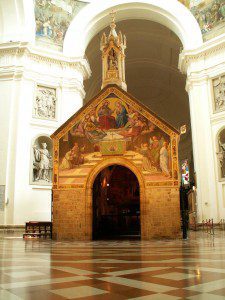
August 2 is a special day for Franciscans throughout the world. It recalls the small chapel near Assisi that became the spiritual home of St. Francis and his first companions—the Portiuncula. Rich in Franciscan memory and tradition, the chapel’s legacy has reached far beyond Assisi, even influencing the name of Los Angeles, California.
The City of Angels
Los Angeles is widely known as the “City of Angels,” but its name is a shortened form of a much longer Spanish name. The pueblo founded in 1781 was commonly known as El Pueblo de Nuestra Señora la Reina de los Ángeles de Porciúncula—“The Town of Our Lady the Queen of the Angels of Porciúncula.”
Los Angeles was founded as a Spanish pueblo, or settlement, rather than as a Franciscan mission. Its name reflects the Catholic and Franciscan culture of Spanish California and recalls the Marian title associated with the Portiuncula chapel in Assisi. Over time, the pueblo grew into the city now known simply as Los Angeles.
To understand the Franciscan connection, we return to the early life of St. Francis of Assisi.
Saint Mary of the Angels
Around 1206, while Francis was struggling to discern God’s plan for his life, he prayed in the small church of San Damiano outside the walls of Assisi. There, according to tradition, Christ spoke to him from the crucifix:
“Francis, rebuild my church, which you see is falling into ruin.”
Francis initially understood the command literally and began repairing the church—stone by stone. He later restored other neglected chapels in the area.
One of these was a small, abandoned chapel in the valley below Assisi that was associated with the Benedictines. It stood on a small parcel of land known as the Portiuncula, meaning “little portion.” The chapel itself was called Saint Mary of the Angels.
Around 1209, Pope Innocent III gave oral approval to Francis’ Gospel way of life and that of his first companions. After staying for a time at Rivo Torto, the brothers settled at the Portiuncula around 1210. The small chapel became the spiritual center of the emerging Franciscan movement and the place from which the friars were sent out to preach the Gospel.
The names Saint Mary of the Angels and Portiuncula help explain the Franciscan and Marian heritage reflected in the early name of Los Angeles.
The Portiuncula Today
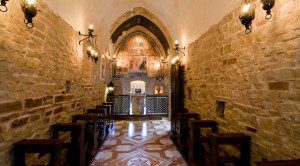
The original chapel still stands today, carefully preserved within the much larger Basilica of Saint Mary of the Angels in Assisi.
For Franciscans, the Portiuncula recalls both the beginning of the Order and the end of St. Francis’ earthly life. It was here that the first brothers gathered and were sent on mission. It was also here that Francis asked to be taken when he knew that his death was near.
Thomas of Celano records that Francis wished to return to the place where he had first come to understand his vocation. As death approached, Francis asked his brothers to sing praises to the Lord, rejoicing not only at the end of his earthly life but at the eternal life that awaited him.
The Portiuncula is the Franciscan Tradition
St. Bonaventure, a Minister General of the Franciscan Order and the author of the Major Life of St. Francis (LgMaj 2:8) wrote:
“When he finally completed this church [San Damiano], he came to a place called the Portiuncula where there stood a church of the most Blessed Virgin Mother of God, built in ancient times but now deserted and no one was taking care of it. When the man of God saw it so abandoned, he began to stay there regularly in order to repair it, moved by the warm devotion he had toward the Lady of the world. Sensing that angels often visited there, according to the name of that church, which from ancient times was called Saint Mary of the Angels, he stayed there out of his reverence for the angels and his special love for the mother of Christ.
This place
the holy man loved more than other places in the world;
for here he began humbly,
here he progressed virtuously,
here he ended happily.
This place
he entrusted to his brothers at his death
as the most beloved of the Virgin.
Before his conversion, a certain brother, dedicated to God, had a vision about this church, which is worth telling. He saw countless people who had been stricken with blindness, on their knees in a circle around this church, with their faces raised to heaven. All of them, with tearful voices and uplifted hands, were crying out to God, begging for mercy and light. Then a great light came down from heaven and, diffusing itself through them, gave each the sight and health they desired.
This is the place
where the Order of Lesser Brothers
was begun by Saint Francis
under the prompting of divine revelation.
For at the bidding of divine providence
which guided Christ’s servant in everything,
he built up three material churches
before he preached the Gospel
and began the Order not only
to ascend in an orderly progression
from the sensible to the intelligible,
from the lesser to the greater,
but also
to symbolize mystically
in external actions perceived by the senses
what he would do in the future.
For like the three buildings he built up,
so the Church
—where there is victory
for the triple army of those being saved—
was to be renewed in three ways
under his leadership:
by the form, rule, and teaching of Christ
which he would provide.
And now we see
that this prophecy has been fulfilled.
The Portiuncula Indulgence
According to Franciscan tradition, while praying at the Portiuncula in 1216, St. Francis asked Christ to grant a special indulgence to those who would visit the chapel with sincere repentance. Tradition holds that Pope Honorius III verbally approved the request.
The historical origins of the indulgence have been debated because the earliest accounts of Francis do not mention it and no contemporary written decree has survived. The oldest known testimony concerning the indulgence dates to 1277 and records information attributed to Brother Masseo, one of Francis’ companions.
Over the centuries, the privilege associated with the Portiuncula was renewed and extended beyond the original chapel. Today, the Portiuncula Indulgence may be obtained from noon on August 1 through midnight on August 2 by making a devout visit to a parish church or a Franciscan church and reciting the Lord’s Prayer and the Creed.
The usual conditions for receiving a plenary indulgence also apply:
- Sacramental Confession
- Reception of Holy Communion
- Prayer for the intentions of the pope
- Freedom from attachment to sin, including venial sin
The Portiuncula Indulgence continues to invite the faithful to experience God’s mercy, renew their relationship with Christ, and deepen their commitment to the Gospel.