


“Humanity, created by God in all its grandeur, is today facing a pivotal choice: either to construct a new Tower of Babel or to build the city in which God and humanity dwell together.” | Magnifica Humanitas 1
Marking the 135th anniversary of Rerum Novarum, the document written by his namesake Pope Leo XIII and credited as the cornerstone of modern Catholic social teaching, Pope Leo XIV has released his first encyclical, entitled Magnifica Humanitas: On Safeguarding the Human Person in the Time of Artificial Intelligence. “He appeals for the safeguarding of humanity, promotion of truth, dignity of work, social justice, and peace,” wrote Isabella Piro of Vatican News on release day.
Signed on May 15, 2026, the Feast of Saint Isidore, patron of farmers, peasants, and rural laborers, and released ten days later, the pontiff provides us “a powerful reminder that no technology can replace a child of God, and all technology should be placed at the service of helping humanity thrive,” said Archbishop Paul S. Coakley, president of the U.S. Conference of Catholic Bishops.
“We encourage all people of good will to reflect on this rich papal teaching and to seek ways in which to apply it in their lives,” Bishop Coakley continued. “As his predecessor Pope Leo XIII addressed the challenges of the Industrial Revolution in Rerum Novarum one hundred thirty-five years ago, our Holy Father shines the light of the Gospel and the tradition of the Church on the new opportunities and challenges posed by the rise of Artificial Intelligence. The Pope calls us to never lose sight of the inherent dignity of all human life and the moral imperative for technology to support peace and the common good rather than the limited interest of a few.”
An encyclical is a formal papal letter sent by the Pope to all Roman Catholic bishops. Derived from the Greek word enkyklios, meaning ‘circular’ or ‘general,’ these documents are among the highest levels of papal teaching, used to provide guidance on faith, morals, or major social issues.
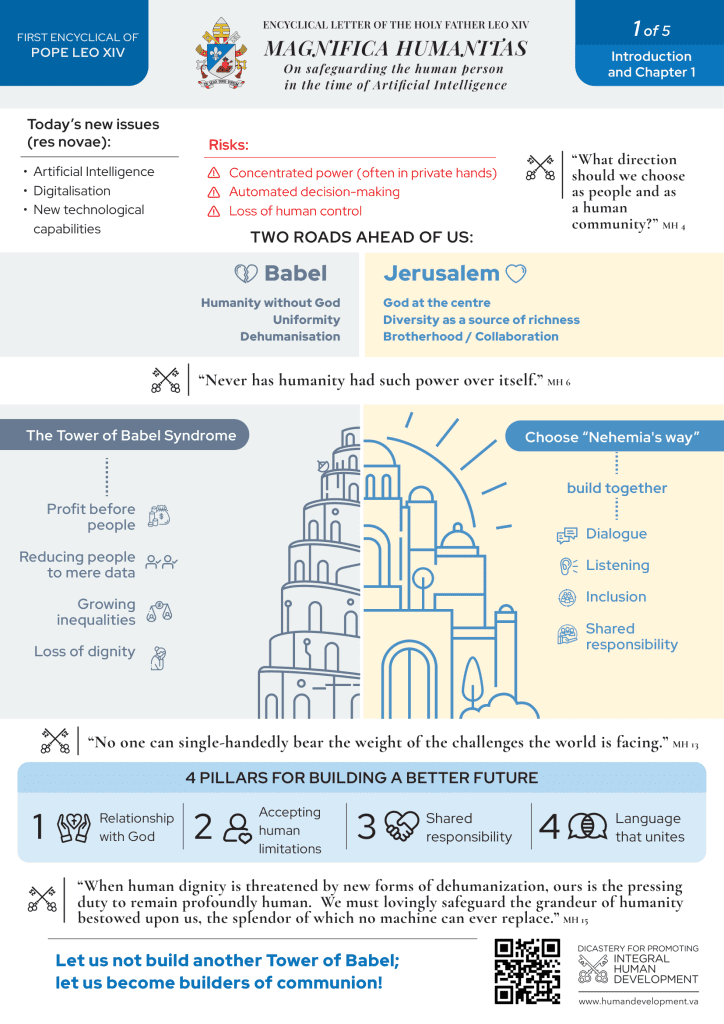
“Magnifica Humanitas is a theological reflection on AI and its impact on the human person and society,” says Fr. Steve Kluge, OFM. “He writes that AI is not the solution to humanities problems. Much like his predecessor, Pope Leo XIII, in Rerum Novarum highlighting the too often damaging impact on people of the working classes during the industrial revolution, Leo XIV, in this new encyclical, reminds us that AI is not evil in and of itself, but “takes on the characteristics of those who design, finance, regulate, and use it” and encourages it to be used for the common good of all people.”
Parishioners who review the document will undoubtedly see how the development of AI has potential influences and impacts on every facet of life, from the more mundane administrative or task-based advancements that might make life and work easier, through to the potential abuses or negative impacts the technology could unknowingly assist.
As mentioned at the release of Dilexi Te, Pope Leo XIV’s first apostolic exhortation, it is no secret that Cardinal Robert Francis Prevost chose the name Leo to connect his papacy to the Leo XIII. St. Pope John Paul II wrote on the 100th Anniversary of Rerum Novarum, “’In the face of a conflict which set man against man’ Leo (XIII), for the first time, both established and firmly defended the Church’s moral authority to promote justice in public life and, by so doing, ‘created a lasting paradigm for the Church’”. This new encyclical truly takes the baton from Leo XIII, examining a new industrial revolution and a time in which justice can be obscured not only by those who are helping create and utilize this new technology, but by the technology itself.