Category Archives: Parish News

The Clearest Moment | Friar Reflections | The Baptism of the Lord

My Good Friends,

Today we celebrate the Baptism of the Lord, and it’s worth starting with the obvious question people have been asking for centuries: Why does Jesus get baptized at all?

John’s baptism was about repentance. It was for people who needed to turn their lives around. So why does the sinless Son of God step into that same muddy Jordan River? And the answer is simple—but not shallow. Jesus doesn’t enter the water because He needs to be cleansed. He enters the water because we do. This moment is not about Jesus changing. It’s about the water changing.

By stepping into the Jordan, Christ sanctifies the waters of the world. From that point on, water is no longer just water. It becomes a place of encounter—where heaven touches earth, where God chooses to act.

And notice what happens. The heavens open. The Spirit descends. The Father speaks.

This is one of the clearest moments in the Gospels where the Trinity reveals itself—not in theory, not in a creed, but in an event. God shows us who He is by what He does. And what does the Father say? “This is my beloved Son, with whom I am well pleased.” Not after Jesus has performed a miracle. Not after He’s preached a sermon. Not after the Cross. Before all of it.

Which tells us something important: Jesus is loved not for what He does, but for who He is.

And here’s where this feast turns toward us. Because in our baptism, something very similar happens—whether we remember it or not. The heavens are opened. The Spirit is given. And the Father claims us. You may not have heard a voice from the clouds. Most of us were infants, after all. But the Church dares to say that the same truth spoken over Jesus is spoken over you: You are my beloved child. I delight in you. Not because you’ve earned it. Not because you’ve gotten everything right. But because you belong to Christ.

The Baptism of the Lord marks the end of Christmas, but it also marks the beginning of mission. Jesus comes up out of the water and immediately moves toward the desert, toward ministry, toward the world as it actually is.

Which reminds us: baptism is not a private comfort—it’s a public calling. We are baptized not just from something—sin, death—but for something: to live as sons and daughters who know they are loved and therefore are free to love in return.

So today, as Christmas fades and ordinary time begins, the Church quietly asks us one question: Do you remember who you are? Not your job. Not your failures. Not your worries. But this: You are baptized. You are claimed. You are beloved. And that is where the Christian life always begins.

Peace and All Good,
– Fr. Zack

The Spirit of Assisi | From the Desk of the Pastor | January 2026

Dear Parishioners,

I would like to share with you a reflection someone has sent me on the World Day of Peace.

Established by Pope Paul VI in 1967, the World Day of Peace is celebrated annually on January 1st, coinciding with the Solemnity of Mary, Mother of God. It was inspired by the encyclicals Pacem in Terris (John XXIII) and Populorum Progressio (Paul VI), the first observance was held on January 1, 1968.

Each year, the Pope publishes a formal message addressed not just to Catholics, but to “all men of good will” and heads of state. This message serves as a magisterial declaration on social doctrine, covering issues like human rights, economic justice, and international diplomacy.

The theme for the 59th World Day of Peace (January 1, 2026) is “Peace Be With You All: Towards an ‘Unarmed and Disarming’ Peace.” It emphasizes that peace should not be rooted in fear or weapons (“unarmed”) and must have the power to open hearts and resolve conflict (“disarming”).

The “Spirit of Assisi” is a landmark concept in Catholic interreligious dialogue, born from the World Day of Prayer for Peace held on October 27, 1986. Initiated by Pope John Paul II, it brought together 160 religious leaders—including Hindus, Buddhists, Muslims, Jews, and traditional African religions—to the birthplace of St. Francis to pray for peace during the Cold War.

The original 1986 gathering was a bold response to the Cold War’s height. For the first time in history, the Catholic Church did not invite other faiths to convert or debate, but to stand side-by-side.

John Paul II was careful with his language to avoid the charge of “syncretism”—the blurring of distinct religious identities into a vague, single faith. He famously stated that they had not come to “pray together,” but to “be together to pray.” Each tradition was given its own space to offer prayers according to its own rites, after which they walked in silence together toward the Basilica of St. Francis.

While the event was hosted by the Vatican, its success depended on how non-Christian traditions viewed the invitation. For many, it was a move from being “objects of mission” to “partners in peace.”

For the Muslim delegations, the Spirit of Assisi resonated with the Quranic injunction that God created different nations and tribes “that you may know one another” (49:13). Many Muslim leaders viewed the event through the historical lens of St. Francis’s 1219

meeting with Sultan al-Malik al-Kamil during the Crusades—a rare moment of medieval respect. Islamic representatives saw the gathering as a platform to declare that “genuine religious belief is a source of harmony” and that the use of religion for violence is a “terrible abuse.”

The Spirit of Assisi is built on several core convictions articulated by successive Popes:

  • Universal Brotherhood: The belief that all humans share a common origin and destiny, making peace a universal duty.
  • The Power of Prayer: A conviction that peace is not merely the result of political negotiations but a gift from God that must be sought through humble prayer.
  • The Rejection of Violence: A solemn declaration that “whoever uses religion to foment violence contradicts religion’s deepest and truest inspiration.”
  • Identity and Alterity: Encouraging believers to be “pilgrims” who are firm in their own faith while remaining open to the “other” as a brother or sister.

Assisi is often called a “Prophecy of Peace.” In an era where religion is frequently weaponized to fuel conflict, the Spirit of Assisi offers an alternative narrative. It posits that the more deeply one enters into their own faith, the more they find a common human longing for the Transcendent and for the peace that “surpasses all understanding.”

Today, the “Spirit of Assisi” has evolved from a single historical event into a practical framework for addressing modern global crises. In our current context of deep political polarization and digital echo chambers, it offers several vital lessons for the 21st century:

  • A Counter-Narrative to the “Clash of Civilizations”: In a world where religion is often blamed for conflict, the Spirit of Assisi provides a “prophecy of peace.” It demonstrates that religious identity can be a bridge rather than a barrier, offering a direct rebuttal to the idea that different cultures are destined for inevitable conflict.
  • The “Theology of the Neighbor”: It shifts the focus from abstract theological debate (which often divides) to shared ethical action (which unites). Today, this means interfaith cooperation on global issues like climate change, migration, and poverty. It suggests that “saving our common home” is a spiritual duty shared by all traditions.
  • Human Fraternity over Uniformity: It teaches us how to coexist without erasing our differences. By emphasizing the “gift of peace,” it encourages a “culture of encounter” where we don’t just tolerate the “other” but recognize their inherent dignity. This is particularly relevant in multicultural societies struggling with social cohesion.
  • The Role of Silence and Prayer in Diplomacy: In an era of “loud” social media and aggressive rhetoric, Assisi’s emphasis on silence, pilgrimage, and prayer reminds us that peace requires internal work. It suggests that political solutions are more sustainable when backed by a shared moral and spiritual commitment.

In short, for us today, the Spirit of Assisi means active, collaborative hope. It is the belief that when people of faith (and no faith) stand together, they become a more powerful force for good than any political or military power.

The Spirit of Assisi remains a “prophetic gesture.” It suggests that in a fragmented world, the path to peace requires not just treaties, but a spiritual “workshop” where leaders of different faiths can offer a counter-narrative to violence through silence, pilgrimage, and mutual respect.

Peace and All Good,
Fr. Mike

Concluding Our Jubilee Year of Hope

A little over a week after the date of this publication, our journey through the Jubilee Year of Hope will come to an end. On December 24, 2024, we were invited to become “Pilgrims of Hope,” sharing the message of hope in Christ within our families and our communities, and growing in that hope in our own lives.

The practice of a jubilee year has ancient roots. In 1300, Pope Boniface VIII instituted the first Christian Jubilee, a year set aside to encourage the faithful to embark on pilgrimages, to repent of their sins and forgive the sins of others, and to renew a focus on the spiritual life. Since then, the Church has designated each new Jubilee as a special year of grace and forgiveness, offering the faithful an opportunity to obtain a plenary indulgence. Originally occurring every 50 years, this practice is now observed every 25 years, and serves as a reminder of God’s love, mercy, and continual call to conversion.

Pilgrimages are a powerful way to inspire faith whether by walking in the footsteps of Jesus in the Holy Land, visiting sites significant in the lives of saints, or by visiting historic churches. For many, travel to the Vatican might be a once-in-a-lifetime opportunity, and maybe that opportunity wasn’t economically or logistically feasible this year. A trip to the Holy Land similarly may have been difficult, but for reasons that are disheartening, as conflict has embroiled the region. At a Mass that kicked off our local celebration of the Jubilee, Bishop Gregory Parkes mapped out our personal pilgrimage through this Year of Hope, regardless of any opportunities to travel abroad: “As pilgrims of hope, we are called to live out the call to seek Christ, the source of our hope and the source of the meaning for which we long, in all that we do and in every moment of our lives.”

Bishop Parkes called on Sacred Heart to serve as one of six official Places of Pilgrimage within the Diocese of St. Petersburg throughout the Jubilee Year. The full list included the Cathedral of St. Jude, as well as one church from each the five counties in the diocese. Our parish saw an uptick in visitors through this designation. Docents from the Historical Society have provided dozens of additional tours this year, to visiting groups from across the state and southeast and pilgrims from as far off as Sweden or South America. Pilgrimage passports were handed out to those making the trek across the diocese, with prayers and instructions for the plenary indulgence afforded to those making the local journey. The diocese also promoted a way for children to get involved, creating a cartoon image of Bishop Parkes for families to take photos with while visiting the local sites.

If this Jubilee itself hasn’t been enough of a historical moment, many that had the chance to travel to the Vatican were greeted by another. With the election of Robert Francis Cardinal Prevost to the papacy, becoming Pope Leo XIV in early May, their time in Rome coincided with an early chance to hear from the first American pope in person during the Angelus or General Audiences.

“It is hard to describe the feeling that you have when you are there,” said Fran Provenzano, a long-time parishioner who is currently chair of Sacred Heart’s Outreach Committee. She and her husband Jerry were able to visit the Vatican for the Jubilee as part of a larger trip across Italy. “It was pouring with rain the day that we were there, and yet you felt a togetherness, and a humbleness, that made it feel as if it were a perfect day.

“People were sharing umbrellas and taking care of each other, and Pope Leo exuded this aura of humility and openness during his address. It was truly something special.”

“As I walked through the Holy Doors, I distinctly remember praying to God for peace in our world,” said Tony Miranda, Sacred Heart’s business operations manager. Miranda was able to visit the Vatican over the summer before beginning his new role on the parish staff. Holy Doors are special entrances in major Catholic basilicas, only opened during Holy Years (Jubilees) by the Pope, symbolizing a passage from sin to grace and a deeper connection with Christ, allowing pilgrims to receive indulgences.

Originally, there was only one door, at the Basilica of St. John Lateran, which is the cathedral of the Bishop of Rome. Later, to allow as many pilgrims as possible to take part in the Jubilee experience, the other Roman Basilicas also opened their own Holy Doors, including St. Peter’s, St. Mary Major, and St. Paul Outside the Walls. Pope Francis opened a new door for Jubilee 2025, in Rebibbia Prison, Rome, signifying hope and mercy for all, including prisoners. On Gaudete Sunday, Pope Leo XIV presided over the final major celebration of the Holy Year, calling for renewed commitment to justice, rehabilitation, and hope during a Mass dedicated to prisoners in St. Peter’s Basilica, attended by around 6,000 pilgrims from some 90 countries. An estimated 32-35 million Catholics will have made the trip to Rome by the Jubilee’s end on January 6, 2026, when the Holy Doors will shut, and end what has certainly been a year filled with hope.

Text by Rob Boelke | Director of Communications

Gentle Instructions | Friar Reflections | Gaudete Sunday

My Good Friends,

Throughout our liturgical cycles, we don’t seem to hear much from The Epistle of James and for me, on this Third Week of Advent, I find his message to us quite poignant, even uplifting on this Gaudete “Rejoice” Sunday. Advent has a funny way of holding two opposite feelings at the same time: quiet expectation and frantic busyness. We’re lighting candles and singing about waiting for Jesus, but we’re also rushing, putting up trees, decorating, shopping, visiting and stressing, and wondering how to get it all done so that we may be able to relax a bit.

And into that mix, James drops a surprisingly grounded message: be patient. He doesn’t mean “sit around and do nothing.” He uses the image of a farmer waiting for the precious harvest. Farmers don’t just stare out the window hoping something grows, they prepare the soil, plant, water, watch the weather, and trust a process they don’t fully control. That can be a way for us to look at Advent. It’s not passive waiting; it’s hopeful tending. It’s showing up in small, steady ways even when you can’t see any immediate results.

“Strengthen your hearts.” says James. It’s such a gentle instruction. Again, not telling us to pull ourselves together or pretend everything’s fine. He’s inviting us to make room for hope, to shore up the inner places where we’re tired, discouraged, or stretched thin. If we allow it to, Advent can give us little practices that help with that: a candle lit in the dark, a moment of quiet after a long day, a simple prayer whispered on the go. These tiny acts strengthen us more than we realize. And then comes the line that hits a little too close to home: “Do not grumble against one another.” It’s almost as if James knew what the holidays can do to people, how stress can make us short with each other, how waiting can make us edgy, how closeness with others can reveal our impatience. But James’ point isn’t to shame us; it’s to remind us that waiting is something we do together. The season of Advent is meant to be communal, in support of each other in the tension between the already and the not-yet. other in the tension between the already and the not-yet. Finally, James points us back to the prophets, the people who waited, hoped, struggled, trusted, and kept going. Their lives remind us that God works slowly sometimes, but never absentmindedly. Even when it feels like nothing is moving, God is not idle. The struggle is real!

The invitation of James during Advent is simple: Be patient, because God is close. Tend to your heart, because hope grows slowly. Be gentle with each other, because we’re all waiting for something, and remember that God is preparing something worth the wait. So Rejoice and be hopeful this Gaudete Sunday!

Peace and All Good,
– Fr. Zack

The Gift of this Season | From the Desk of the Pastor | December 2025

Dear Parishioner,

As we approach the Christmas season, many of us have already started singing and listening to Christmas music and going to Christmas parties. When doing these things, do we truly take the time and reflect on what our faith and Christmas is all about?

In the song The Twelve Days of Christmas, there are hidden symbols of faith, with each gift representing key elements of Catholic doctrine and the celebration of Jesus Christ’s birth. The 12 Days traditionally begin on December 25 (Christmas Day), and end on January 5 (Twelfth Night) with the celebration of the Epiphany on January 6. For Catholics, the Christmas season then ends with the Baptism of the Lord on the following week.

Symbolism of Each Gift:

  • A Partridge in a Pear Tree: Represents Jesus Christ, who sacrificed Himself for humanity. The partridge is known for its protective nature, symbolizing Christ’s sacrificial love.
  • Two Turtle Doves: Symbolize the Old and New Testaments, representing the complete story of the Christian faith and God’s plan for salvation.
  • Three French Hens: These stand for the theological virtues of faith, hope, and charity (love), as described in 1 Corinthians 13:13. They also represent the Holy Trinity: the Father, Son, and Holy Spirit.
  • Four Calling Birds: Represent the four Gospels: Matthew, Mark, Luke, and John. These Gospels convey the good news of Jesus Christ and guide believers in understanding His teachings.
  • Five Gold Rings: Symbolize the first five books of the Old Testament (the Torah), which outline the creation of the world and God’s covenant with humanity.
  • Six Geese a-Laying: Represent the six days of creation, reflecting God’s work in forming the world.
  • Seven Swans a-Swimming: Symbolize the seven gifts of the Holy Spirit, which include wisdom, understanding, counsel, fortitude, knowledge, piety, and fear of the Lord.
  • Eight Maids a-Milking: Represent the eight Beatitudes, which are teachings of Jesus that outline the attitudes and behaviors that lead to true happiness.
  • Nine Ladies Dancing: Symbolize the nine fruits of the Holy Spirit, which include love, joy, peace, patience, kindness, goodness, faithfulness, gentleness, and self-control.
  • Ten Lords a-Leaping: Represent the ten commandments, which are fundamental laws given to guide moral behavior.
  • Eleven Pipers Piping: Symbolize the eleven faithful apostles, who spread the teachings of Jesus after His resurrection.
  • Twelve Drummers Drumming: Represent the twelve points of doctrine in the Apostles’ Creed, summarizing the core beliefs of the Christian faith.

One trivia question that we often hear during this time is“How many gifts are in the Twelve Days of Christmas?” My mother would always answer “364, one for every day of the year with Jesus being born on Christmas as the first gift.” This song reminds us that it is not just about doing good for one day of the year but it should be for the 365 days of the year.

In 2025, we celebrated a year of Mercy and Bishop Parkes asked all of us to do Corporal Works of Mercy as part of a diocesan-wide campaign. Perhaps we should each adapt this song to doing acts of Mercy. “On the first day my act of mercy was to ….”

Be creative in writing your own song of mercy based upon your acts that you have done this past year of what you plan to do next year.

Happy Advent! (Christmas, you have to wait a few more weeks)

Peace and All Good,
Fr. Mike

A Call to Prayer and Action

By Jim Rossman, Men’s Prayer Group

Dear Men of Sacred Heart,

What would inspire you to prepare for an event at 7:30 a.m. on a Friday morning?

  • A golf outing with good friends
  • Preparation to attend the “Super Bowl”
  • Early to the airport for an international trip
  • Preparing mind and soul to live the life of faith God calls us to perform

I’ve gotten up for all of these reasons and more —- and, for the last ten years, on every Friday morning at 7:30, I have met with men of Sacred Heart for coffee and breakfast snacks, for the warmth of deepening friendships, and, most importantly, to discuss subjects —- personal, social, worldly, issues of morality and faith, opportunities for service to parish and community —- our emphasis always on developing understanding, humility, gratitude and joy.

The Men’s Prayer Group (which in earnest is more of a “Discussion Group”) meets every other Friday at the North Campus for an hour. We have a theme for each meeting —- usually a perspective on a moral issue; a Catholic view on happenings in the world; the pressing needs of the poor; our longing for community and belonging; what God is calling us to do with our lives; to reflect on our own pathway to holiness; and to offer thanksgiving for the overwhelming blessings we have received. Most of our hour together is spent at tables of 5-6 men sharing our thoughts on the subject in small groups. We wrap up with each table sharing their learnings with the entire group.

Frequently, our discussions lead to a “call to action” and most of our men find their way to a Parish ministry where they can engage in community service. Our men have also begun new ministries to serve our neighbors in need — such as, Bikes from the Heart, Love INC, Portico Housing, and Dorothy Day Tampa.

If you want to meet other Sacred Heart men of all ages who are serious about friendship, energized by discussion of Christian values, learning to more fully practice our faith in a culture of chaos, understanding what God is asking of us, and accepting the unconditional love and empowering grace the Holy Spirit showers on us —- please sacrifice that extra hour of sleep and join us next Friday, December 5 (7:30 a.m.) at the North Campus.

We will also hold an Open House in the Alumni Hall at the North Campus, Saturday, December 6, from 9 to 10 a.m. Please plan on attending to meet some of our members and to learn more about who we are and what we do. We will also discuss the possibility of beginning an evening meeting time for those men who simply can’t balance sleep, work schedules and a 7:30 a.m. meeting time. Learn more about our group at shfla.org/mpg.

Our Christmas Poinsettias

A long-standing Sacred Heart tradition, parishioners and visitors alike donate the poinsettias that you see adorning our altar in honor of loved ones they wish to remember during the Christmas season.


2025 Digital Memorial Book

We would like to thank all who donated in memory of their loved ones, as those donations help create the beautiful atmosphere within our church during the 2025 Christmas season.

As part of that tradition, we memorialize their loved ones in a digital book, found here.


2025 Order Information

Remember a loved one during the Christmas season with a poinsettia used to decorate our sanctuary. A long-standing Sacred Heart tradition, each plant that you see has been given in remembrance or honor of loved ones whose names will be memorialized online.

*NEW* Poinsettias can now be ordered online through our parish Mass intention and Memorials request page. Simply click on “Request Memorial” on the top, right corner of the page, and select any available day in December.

Request forms can be found on the table near the church entrance, or at the link below. All forms, along with the suggested donation of $20 per plant, must be received by Thursday, December 18.

Click here to order your 2025 Poinsettia Memorial online

Click here to download your 2025 Poinsettia order form

Ah, now we find the hope! | Friar Reflections | 33rd Sunday in Ordinary Time

Saints of God…

…the Lord be with you!

As we come to the end of the liturgical year, the readings this Sunday have, for the most part, an ominous tone with just a hint of hope. In the first reading taken from the Book of the Prophet Malachi (3: 19-20) the prophet warns his listeners that, “The day is coming, blazing like an oven, when all the proud and all evildoers will be stubble, and the day that is coming will set then on fire.” (YIKES!)

In today’s Gospel from Luke (21:5-19), Jesus says to those who are remarking on the beauty of the Temple, “All that you see here-the days will come when there will not be left a stone upon another stone that will not be thrown down.” (Another YIKES!) You may be saying to yourself, “I thought the message is supposed to be Good News.” Well, it is. But sometimes you must be attentive and persistent enough to discover it. So where is the Good News in today’s readings?

Well first, the readings remind us that nothing in this life is permanent. Buildings may last a long time, but at some point, even the pyramids will crumble. At some point, we all will die; our bodies turned to dust or ashes. Our spirits/souls live on in because of God’s good grace, but at some point, no one alive in this world will remember us. Although cyclical, at some point, all liturgical seasons come to an end, only to give birth to another liturgical season and another new church year. Maybe the point is “at some point.”

Who are we called to be and what are we called to do until the “at some point” arrives? Ah, now we find the hope! Malachi writes that for those who fear (stand in awe of) the Lord there will arise the “sun of justice with its healing rays.” At the end of today’s Gospel Jesus says, “By your perseverance you will secure your lives.” Our collect (opening prayer) calls God the Father to grant us “constant gladness of being devoted to YOU (Father) and to serve with constancy the author of all that is good.” So, who should we be, and what should we be doing? Continue to be who you are in Christ. Continue to be Christ to one another, in your families, places of work and communities, and in the parish of Sacred Heart. Continue to minister to Christ by feeding the poor, being kind to the unhoused, being an usher at Mass, collecting or giving to the St. Vincent de Paul Society, helping Bikes from the Heart, serving with Hands of Hope, or Giving from the Heart, raising your voices in song by joining the choir…

There is so much we can do, and in the doing we will become more and more like Christ.

– Fr. Steve

December Drive Aims to Build Backpacks w/ Resources for the Homeless

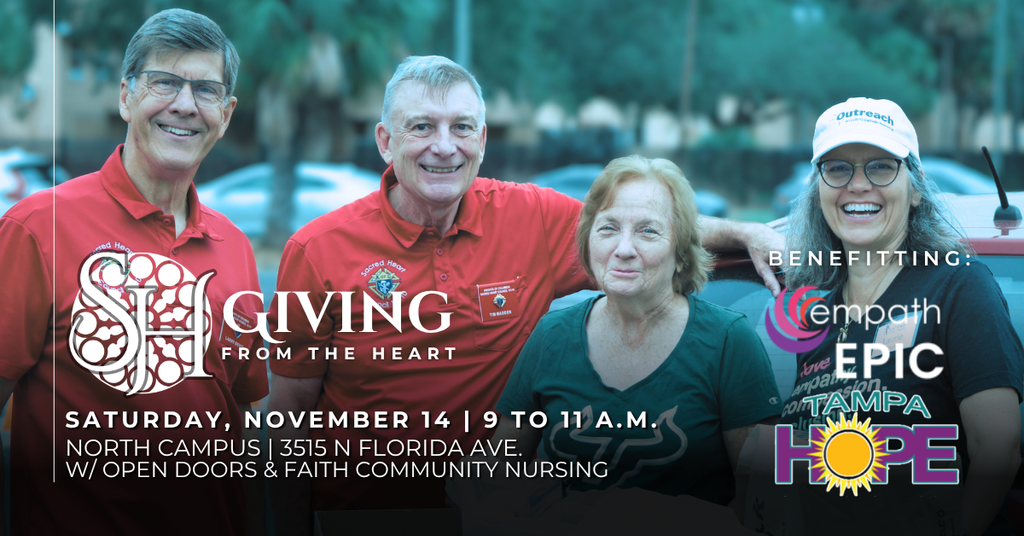
Parish-wide efforts to meet the needs of the Tampa/Hillsborough County community continue on December 13, at the North Campus with our next Giving from the Heart drive-through donation event. Volunteers from our Outreach Committee will be gathered from 9 to 11 a.m. to receive items and assemble Christmas Care Packages for the Homeless served by Hands of Hope.


Can’t make it to the North Campus on the day of the drive?

Click the image to access our Amazon Wishlist, and have your donation shipped directly to the parish office!


The emphasis our December drive is to build out backpacks filled with winter essentials for the unhoused and homeless clients that Hands of Hope assists each weekend. The Outreach Committee has set a goal of 100 total backpacks that will include:

Toiletry/Personal Hygiene Kits | Bug Spray or Mosquito Repellent Bracelets | Granola / Snack Bars | Blankets | Snack Sizes of Chips/Crackers/Cookies | Lanterns | Sweatshirts or Hoodies (30 Women, 70 Men, L-XXL sizes) | Cough Drops and/or Hard Candy | Flushable Wipes | Hand Warmers | Gloves | Knit Hats or Beanies | Bus Passes | Phone Chargers (new or used in working order)

Needed items are available both individually and in bulk on the Amazon Wishlist. Our hope is to have all 100 backpacks filled on the day of the drive, so we ask that parishioners and would be donors to consider purchasing items from the list in advance of the drive, especially the Backpacks, Lanterns, Sweatshirts, and Gloves. If you cannot make the drive, but have gently used items in hand that you would like to donate, you may visit the parish office during business hours (M-F, 9 a.m. to 3 p.m.) to drop off your donation.

Hands of Hope is an outreach ministry of Sacred Heart that has been serving the poor and homeless of our community for more than a decade. Each weekend, a meal is prepared and then served to our neighbors in need at the North Campus. Throughout the day, volunteers share fellowship and resources of hope and healing for the physical, mental, and personal needs of their guests.

If you are interested in assisting the parish and ministry with any large donations of these specific items, please click here to contact business operations manager Tony Miranda via email.

Our parish has the opportunity to provide our local homeless with the hope that embodies the Christmas season. We hope you have the chance to assist us in providing them with these needed supplies. As always, your generosity is greatly appreciated.

Walking The Camino Inglés | Friar Reflections | Lateran Basilica

“A Journey from Doing to Being: I thought I’d share some thought from recent small walk in Spain…

There’s a saying among pilgrims: “You don’t walk the Camino; the Camino walks you.” For many, the Camino Inglés — the English Way — begins at the ports of Ferrol or A Coruña and ends, as all the great Caminos do, at the tomb of St. James in Santiago de Compostela. But beneath the miles and blisters, the Camino is not about reaching a place — it’s about being reshaped by the journey.

It’s the road that teaches you to slow down: When you first set out, your mind is full of plans — kilometers to cover, towns to reach, photos to take. But somewhere after the second or third day, the road teaches you something quieter: that haste is the enemy of grace. On the Camino, you learn that the soul moves at the pace of your feet. You cannot rush your healing, your forgiveness, or your awakening.

The Franciscan spirit invites us to this same stillness — to notice the small things: the morning mist, the taste of simple bread, the sound of our breath. In those moments, you realize that God is not only at the destination, but walking beside you in every step.

It’s the Weight of the Pack: Every pilgrim learns that what you carry matters. Your backpack — like your heart — gets heavy when filled with too much. By the second day, you start shedding things: an extra shirt, a bottle, maybe a book you thought you’d read.

This too is Gospel wisdom, “Take nothing for your journey,” Jesus said. (Luke 9:3)

The Camino becomes a living parable of detachment. You begin to see how much of life’s burden comes from carrying what is not needed — old grudges, fears, plans that never were. Every item left behind is a confession. Every lighter step, an act of faith.

It’s the People You Meet: On the Camino, you meet strangers from all nations and even from Tampa! Some walk fast, others slow; some talk much, others walk in silence. You share food, laughter, bandages, and sometimes tears.

Soon you realize that you’re not just walking your Camino — you’re walking ours. The real pilgrimage is not through Spain’s countryside but through the human heart — through the encounters that stretch it open. As Francis said: “It is in giving that we receive.” Every shared loaf, every word of encouragement becomes Eucharist on the road — bread broken and given.

It’s the Blisters of Grace: Every pilgrim knows pain — sore feet, aching shoulders, unexpected rain. But somehow, those hardships are part of the blessing. Without them, the joy at the Cathedral would not mean as much. Grace often wears the disguise of discomfort. What rubs us raw can also make us real.

“My grace is sufficient for you, for power is made perfect in weakness.” (2 Corinthians 12:9)

In the Franciscan sense, suffering is not to be avoided but embraced as a teacher. The Camino’s blisters remind us that the Christian life is not about comfort, but conversion — a continual turning toward love.

Arrival and Homecoming: When you reach Santiago, you are greeted by a sea of pilgrims. You may feel joy, or tears, or strangely… emptiness. Because what you’ve truly discovered is that the destination was never a place, but a Person — Christ Himself, who has been walking with you all along. And when you return home, the Camino continues — in your patience with others, in your gratitude for simple things, in your new awareness of God’s quiet presence.

As one pilgrim once wrote: “The Camino doesn’t end at Santiago. It begins there — in the way you now live your ordinary days.”

In closing, what I have shared are the simplest of my thoughts along the way. I believe I may have mentioned once before that one need not travel far to embark on a Camino but simply let your Camino be enchantment of the world around with new eyes and a willing heart. I’d like to express my gratitude for all with whom have made this “walk” a reality for me and my companions along the way. We are all the richer from the experience which will stay with us for some time.

Buen Camino!
– Fr. Zack