


Category Archives: Parish News

He Doesn’t Wait | Friar Reflections | 11 SIOT

My Good Friends,

One of the things I love about today’s readings is that they remind us that God doesn’t wait for perfect people before He calls them.

In the first reading, God tells Israel, “I carried you on eagle’s wings and brought you to myself.” Before Israel accomplished anything, before they proved themselves, God loved them and chose them. The same is true for us. Our relationship with God doesn’t begin with our achievements. It begins with His love.

St. Paul takes that idea even further. He says that Christ died for us while we were still sinners. Not after we got our lives together. Not after we figured everything out. While we were still struggling. God’s love always comes first.

Then we come to the Gospel. Jesus looks at the crowds and sees people who are exhausted, confused, and searching for direction. In other words, He sees people a lot like us. And His response isn’t frustration. It’s compassion. He doesn’t shake His head and walk away. He draws near.

What’s surprising is what happens next. Jesus doesn’t solve everything Himself. Instead, He calls ordinary people—the Twelve—and sends them out. These weren’t experts. They were fishermen, tax collectors, and people with plenty of flaws and weaknesses. Yet Jesus entrusted them with His mission.

That should be encouraging for us. Sometimes we think God can use everyone except us. We imagine that holiness belongs to people who know more, pray better, or have fewer problems. But the Gospel tells a different story. God calls ordinary people and then gives them the grace they need.

St. Francis understood this well. He wasn’t trying to be famous or important. He simply wanted to follow Christ. When he encountered a leper—someone he would normally avoid—he allowed God’s compassion to change his heart. That encounter transformed his life. Francis learned that the Christian life begins when we start seeing others the way Jesus sees them.

The harvest Jesus talks about is still abundant today. All people need encouragement, forgiveness, friendship, and hope. We all are carrying burdens that no one else sees. Most of us won’t be asked to preach to crowds or travel the world. But all of us can offer a kind word, a listening ear, a prayer, or an act of mercy.

The good news is that Jesus isn’t looking for superheroes. He’s looking for disciples, ordinary people. People willing to receive His love and then share it with others.

So the invitation this week is simple: ask Jesus to help us see people with His eyes. If we do that, we may discover that the harvest field is much closer than we thought—in our families, our workplaces, our neighborhoods, and our parish. And we may discover that the ordinary people Jesus is sending into that harvest are us. Amen.

Peace and All Good,
Fr. Zack

Incredible Activity | From the Desk of the Pastor | June 2026

Dear Parishioners,

Peace be with you! We have an incredible amount of activity happening in our parish right now, and I am so energized by the enthusiasm of our young adults who are eager to get involved and do more. As we move into a season of transition and renewal, I want to share several important updates with you.

Farewell and Blessings to Deacon Ray Ferreris: Please join me in congratulating Deacon Ray Ferreris on his new assignment at Incarnation Parish, beginning July 1, 2026. His last Sunday will be June 21, as he celebrates with us at the 7:30 and 9:00 a.m. Masses. A farewell reception will follow immediately after the 9 a.m. Mass in St. Francis Hall. All parishioners are invited to come by to offer him your prayers and well wishes as we say goodbye!

Maintenance Committee Updates: Our facilities require continuous care, and the Maintenance Committee has been hard at work planning essential updates for our worship and community spaces.

  • Main Church Buildings
    • Dome & Choir-Side Exterior Repointing: Work will begin this June to repair the dome and repoint the exterior brickwork on the southern side of the church. This vital structural work is estimated at $282,000.
    • New Wireless Microphone System: To fix the frustrating “dead spots” and drop-offs we have experienced for quite a while, we are replacing much of our wireless microphone system. This $20,000 project will begin soon and greatly improve our sound quality.
  • North Campus Renovations: We are very close to beginning a major renovation of the Kitchen and Auditorium, which we hope will start by late summer.
    • The Scope: The kitchen and restrooms will be gutted to install brand-new electrical and plumbing.
    • We will also be addressing asbestos removal, installing a building-wide sprinkler system, and bringing the facility into full ADA compliance.
    • Please Note: Due to strict budget constraints, we unfortunately cannot replace the roof at this time or purchase all the kitchen equipment we might want. Furthermore, there will be a period of time when the building will be completely closed and unavailable for use.

Looking Ahead | Franciscan Mural Project: We are currently gathering designs for an exciting new mural to be placed on the 11’×12′ exterior wall of the Parish Office building.

  • The goal of this project is to create a visually compelling and spiritually meaningful work of art in downtown Tampa.
  • It will reflect the core values of Franciscan spirituality—particularly humility, compassion, and service to the poor. It is our hope that this mural serves as both a warm invitation and a holy witness, inspiring our own parish family to deepen their faith in action while offering encouragement and hope to everyday pedestrians and visitors.
  • While we do not have a final cost quote yet, we are praying we can secure the funds to complete this beautiful project in celebration of the Jubilee Year of St. Francis of Assisi.

Thank you all for your continued prayers, stewardship, and dedication to our vibrant parish life.

Peace and All Good,
Fr. Mike Jones, OFM

Magnifica Humanitas | On Safeguarding the Human Person in the Time of Artificial Intelligence

“Humanity, created by God in all its grandeur, is today facing a pivotal choice: either to construct a new Tower of Babel or to build the city in which God and humanity dwell together.” | Magnifica Humanitas 1

Marking the 135th anniversary of Rerum Novarum, the document written by his namesake Pope Leo XIII and credited as the cornerstone of modern Catholic social teaching, Pope Leo XIV has released his first encyclical, entitled Magnifica Humanitas: On Safeguarding the Human Person in the Time of Artificial Intelligence. “He appeals for the safeguarding of humanity, promotion of truth, dignity of work, social justice, and peace,” wrote Isabella Piro of Vatican News on release day.

Signed on May 15, 2026, the Feast of Saint Isidore, patron of farmers, peasants, and rural laborers, and released ten days later, the pontiff provides us “a powerful reminder that no technology can replace a child of God, and all technology should be placed at the service of helping humanity thrive,” said Archbishop Paul S. Coakley, president of the U.S. Conference of Catholic Bishops.

“We encourage all people of good will to reflect on this rich papal teaching and to seek ways in which to apply it in their lives,” Bishop Coakley continued. “As his predecessor Pope Leo XIII addressed the challenges of the Industrial Revolution in Rerum Novarum one hundred thirty-five years ago, our Holy Father shines the light of the Gospel and the tradition of the Church on the new opportunities and challenges posed by the rise of Artificial Intelligence. The Pope calls us to never lose sight of the inherent dignity of all human life and the moral imperative for technology to support peace and the common good rather than the limited interest of a few.”

An encyclical is a formal papal letter sent by the Pope to all Roman Catholic bishops. Derived from the Greek word enkyklios, meaning ‘circular’ or ‘general,’ these documents are among the highest levels of papal teaching, used to provide guidance on faith, morals, or major social issues.

Magnifica Humanitas is a theological reflection on AI and its impact on the human person and society,” says Fr. Steve Kluge, OFM. “He writes that AI is not the solution to humanities problems. Much like his predecessor, Pope Leo XIII, in Rerum Novarum highlighting the too often damaging impact on people of the working classes during the industrial revolution, Leo XIV, in this new encyclical, reminds us that AI is not evil in and of itself, but “takes on the characteristics of those who design, finance, regulate, and use it” and encourages it to be used for the common good of all people.”

Parishioners who review the document will undoubtedly see how the development of AI has potential influences and impacts on every facet of life, from the more mundane administrative or task-based advancements that might make life and work easier, through to the potential abuses or negative impacts the technology could unknowingly assist.

As mentioned at the release of Dilexi Te, Pope Leo XIV’s first apostolic exhortation, it is no secret that Cardinal Robert Francis Prevost chose the name Leo to connect his papacy to the Leo XIII. St. Pope John Paul II wrote on the 100th Anniversary of Rerum Novarum, “’In the face of a conflict which set man against man’ Leo (XIII), for the first time, both established and firmly defended the Church’s moral authority to promote justice in public life and, by so doing, ‘created a lasting paradigm for the Church’”. This new encyclical truly takes the baton from Leo XIII, examining a new industrial revolution and a time in which justice can be obscured not only by those who are helping create and utilize this new technology, but by the technology itself.

You can read Leo XIV’s new encyclical by clicking here.

Between His Death and Resurrection | From the Choir Loft

What did Jesus do between His Death and Resurrection?

In recent years at Sacred Heart we have returned to the practice of using the Apostles’ Creed during Sunday Masses in Lent and Easter. This version of the Creed was named after the Apostles, not because tradition says that they composed it, but because it was developed during 800 years of continued apostolic succession to the form we now recognize.

One phrase always causes me to think twice: ‘He descended into Hell’. What did Christ get up to after his death and being laid in the tomb? If, as this Creed affirms, he descended into Hell, what was his purpose there? Why don’t we see this descent represented in the Nicene Creed or any of the Sunday scriptures? Why don’t we hear more about this seismic event?

During my 20 years as Director of Music at the Cathedral of St Marie in Sheffield UK, in addition to the normal celebrations of Triduum, we used to add Sung Morning Prayer and Office of Readings on Good Friday and Holy Saturday and into these liturgies we would insert some additional preparatory rites for the Elect. It was on the morning of Holy Saturday that I got to hear, for the first time, that great reading from ‘the ancient homily for Holy Saturday. I am pleased to learn from Fr. Steve that this same reading is given to the Elect from Sacred Heart at the final stage of their preparation for Initiation at the Easter Vigil.

Hell, in the original understanding was the place of death. Everyone went there when life ceased. It was neither a place of judgment nor torment; that came from St. Bede in 8th century England and, more popularly, from what Dante (1265–1321) imagined in his ‘Inferno’ and from countless ‘fire and brimstone’ homilies in subsequent generations!

Before Christ, no one ascended to heaven but, in this reading, Christ, who is ‘the life of the dead’, extends a hand to Adam to lift him from Hell, and along with him, all those who had died subsequently were also lifted from the underworld to follow Christ to share his glory and the greater life.

In the book Between Cross and Resurrection: A Theology of Holy Saturday Alan E Lewis goes deep into all of this and at one point introduces Christ’s encounter in the place of death with the prophet Isaiah who comments: ‘Now I understand what I meant when I wrote the people who walked in darkness have seen a great light’.

If any of this has got you thinking, allow that ‘light-bulb’ moment to get brighter!

– Philip Jakob,
Director of Music

To read the Holy Saturday Homily that Phil references, click here.

Challenge, Identity, and Mission | Friar Reflections | The Ascension

Saints of God…

the Lord be with you!

In today’s Collect (opening prayer), the Church prays, “Gladden us with holy joys, almighty God…for the Ascension of Christ your Son is OUR Exaltation.” As I often say in O.C.I.A. classes, “Christianity is the most optimistic of all the world’s religions.” There is no greater optimism than believing that the Ascension of Christ is OUR exaltation because human nature, creation, the fully human One is now part of the Godhead. This is our identity and our destiny.

But today’s first reading from the Book of the Acts of the Apostles (1: 1-11) confronts us with a challenge. “He (Jesus) was lifted up, and a cloud took him from their sight. (When) two men dressed in white garments stood beside them (and said) ‘Men of Galilee, why are you standing there looking at the sky?’”. Where do we look for Christ?

Years ago, in the 1970’s, I remember reading a book of theology which said, “If Jesus ascended anywhere, He ascended into the heart of the Church.” That always struck me, and I’ve come to the conviction that we are not to look up to find Christ, but to look for Him still alive, albeit in a new and mysterious way, and active in the world around us particularly in we who are the Church.

Baptized into the baptism of solidarity of Christ, we have received an identity and a mission. Our identity is that we are other Christ’s, and our mission is to live as Christ in the world through acts of charity, forgiveness, and reconciliation. The Spirit given to us at Baptism and in Confirmation gives us power and enables us to live as we should.

By cooperating with the Holy Spirit, we can and do live as Christ more often than we sin. Every time we take care of our family, are kind to the homeless, help the people we work with or our classmates are once again giving Christ flesh in our little corner of the world in 2026.

You, the parishioners of Sacred Heart Parish, embody Christ in so many ways: your generosity in the Catholic Ministry Appeal does good throughout the Diocese. When you support the St. Vincent de Paul Society, Bikes from the Heart, the good deeds of our Knights of Columbus, share your time with Hands of Hope or donate to Giving from the Heart, or offering a smile and a greeting to our homeless men and women, you are being Christ for someone. Today we celebrate that our God in the flesh has mounted His throne. We shout and sing with joy and works of charity!

– Fr. Steve

You’ll Never Walk Alone | Friar Reflections | Sixth Sunday of Easter

My Dear Friends,

The readings for the Sixth Sunday of Easter this year take on a beautiful simplicity when seen through a Franciscan lens: God is not distant, and we are never alone—He is near, dwelling within us and all around us. In the Gospel of John, Jesus promises, “I will not leave you orphans,” and that assurance echoes the spirit of Saint Francis of Assisi, who saw God’s presence not only within his own heart, but reflected in all of creation—brother sun, sister moon, even in suffering itself. The Holy Spirit is not an abstract idea; it is the living presence of God, quietly guiding us toward love, humility, and peace.

Franciscan spirituality invites us to receive this presence with simplicity. We don’t have to strive for greatness or control every outcome. Instead, we are called to be attentive—to notice God already at work in the ordinary: in a morning walk, in a kind word, in the rhythm of breath and prayer. The Spirit forms in us a gentle way of living, where love becomes visible not in grand gestures, but in small, faithful acts. This is how we “keep His commandments”—not through rigidity, but through a life shaped by love.

There is also a quiet courage here. Like the early Christians in the Acts of the Apostles, we are sent into the world not with force, but with peace. A Franciscan heart does not argue loudly; it witnesses softly. It trusts that the same Spirit dwelling within us is already moving in others. This frees us to live with humility, reverence, and a deep respect for every person we encounter.

Ultimately, this Sunday reminds us that God’s presence is not something we chase—it is something we awaken to. And when we do, like Francis, we begin to see the world differently: not as something to grasp or fear, but as a place already filled with God’s love, waiting to be recognized and returned.

Peace and All Good,
Fr. Zack

To the Table | From the Desk of the Pastor | May, 2026

Dear Parishioners,

Our parish joyfully congratulates the children who received First Holy Communion this weekend. After months of prayer, learning, and preparation, they approached the altar for the first time to receive Jesus in the Eucharist—an important and grace-filled milestone in their journey of faith.

We give thanks for these young parishioners and for their families, catechists, and all who supported them along the way. May the Eucharist strengthen them, deepen their love for Christ, and guide them each day as they continue to grow as members of the Body of Christ.

St. Francis of Assisi teaches us to slow down, to gaze with wonder, and to recognize God’s presence hidden in simplicity. Nowhere is this truer than in the Eucharist. With reverent awe, Francis contemplated the humility of Christ, who chooses to remain with us under the gentle signs of bread and wine—quiet, vulnerable, and full of love.

As our First Communicants receive Jesus for the first time, they are invited into this sacred mystery of presence. The Eucharist is not only something we receive, but Someone who comes to dwell within us, shaping our hearts in silence and love. In this simple moment at the altar, heaven bends close to earth, and Christ gives Himself completely, asking only that we receive Him with trust.

In the Franciscan spirit, we remember that this same Christ continues to meet us beyond the church walls—in the beauty of creation, in moments of stillness, and in every person we encounter, especially those who carry suffering or need. Nourished by the Eucharist, we are gently formed to live with humility, compassion, and peace, becoming reflections of the One we receive.

May our First Communicants grow in quiet reverence for this gift, learning to listen for God’s presence in their hearts and in the world around them. Rooted in the love of Christ and inspired by the example of St. Francis, may their lives become a prayer of gratitude, peace, and joyful simplicity.

Please keep our First Communicants in your prayers as they continue to walk with Christ in faith and wonder:

Eve-Marie Armstrong, Leo Barney, Saoirse Bavinger-Sulaimana, Caroline Bentley (receiving May 17), Ava Bouzas, Ella Burch, Derek Busciglio, Viviana Calder, William Coyle, Sophia DuCoin, Claire Ferguson, Evelyn Gargasz, John Hay, Maeve Heffelmire, Price Henderson, Jackson Howard, Peter Linn, Alaiia Lopez, Carter Mairink, Logan Mairink, Nicholas Maniscalco, Michael Martino, Davis McCrory, Cecilia McLamore, Aubrey Mendoza, Cullen Owens, John Pasteur, William Pugh, Mark Sarver, Julian Vazquez.

Prayer for our First Communicants: Loving and humble God, we thank You for the gift of the Eucharist, through which Your Son remains with us in love. Bless our First Communicants as they take this sacred step. May their hearts always recognize Jesus present—on the altar, in creation, and in one another. Form them in the way of St. Francis, to walk gently, to love generously, and to become instruments of Your peace. We ask this through Christ our Lord. Amen.

Peace and All Good,
Fr. Mike

Don’t Run Away | Friar Reflections | Third Sunday of Easter

Saints of God…

…the Lord be with you!

“They (the disciples) stopped, looking downcast.” We find these words in today’s Gospel according to Luke (24:13-35). As we are in the midst of the Easter Season, it might do us well to recall times and circumstances in our own lives that “pulled the rug out from under us”, made us stop, and caused our hearts and spirits to be downcast. What most of us can, or will at some point experience, is the death of a loved one. And this is what the two disciples are experiencing on their journey away from Jerusalem towards Emmaus.

Jerusalem, the place where Jesus the Nazarene was handed over to death by the chief priests and rulers of the people. Jesus the Nazarene, “a prophet mighty in deed and word before God and all the people.” Jerusalem the place they now associate with pain, grief, suffering, cruelty, their own cowardness, and death. No wonder they wanted to get out! To be honest, I would have too.

Yet through an encounter with the Christ they do not recognize, through their offer of hospitality, and the sharing of a meal in which “he took bread, said the blessing, broke it and gave it to them.” Their eyes were opened; Christ is no sooner recognized that He vanishes. Their “hearts burn within them”, their fear is gone replaced with courage and conviction. Grief dies to joy and the two “set out at once and return to Jerusalem” where they hear “the Lord has truly been raised and has appeared to Simon!”

To be honest, we live in uncertain times (but isn’t every time filled with uncertainty). Sometimes I am worried and afraid. But I don’t try to run away (for there is nowhere to run). Instead, I am reminded of the words of St. Peter in our first reading, “God raised Him (Jesus) up, releasing Him from the throes of death, because it was impossible for Him to be held by it.”

We may not be able to control the events around us. But we do have control over how we respond. When in the grip of fear, guilt, pain, depression, or distress, let us turn to our God in faith and recall that because death could not hold Jesus, fear, guilt, pain, depression, or distress does not have the final and ultimate hold on us. Christ does! Christ is Risen! He is Risen indeed!

– Fr. Steve

Helping Ministries Helping Women | Giving from the Heart | May 2026

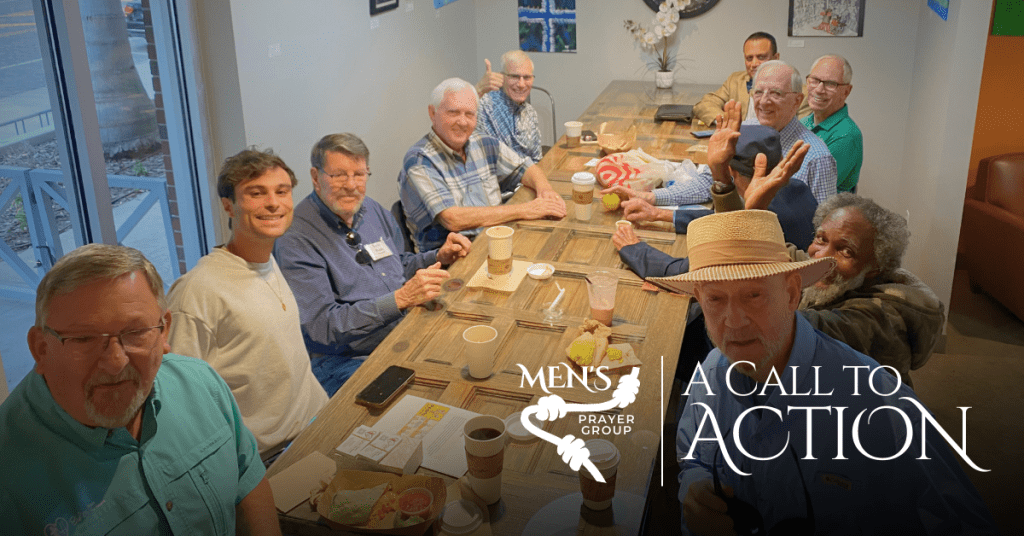
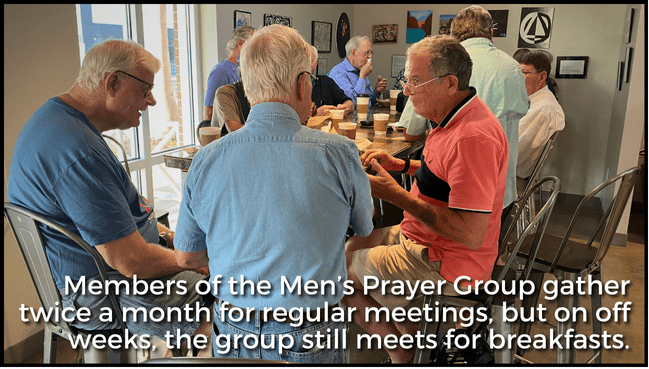
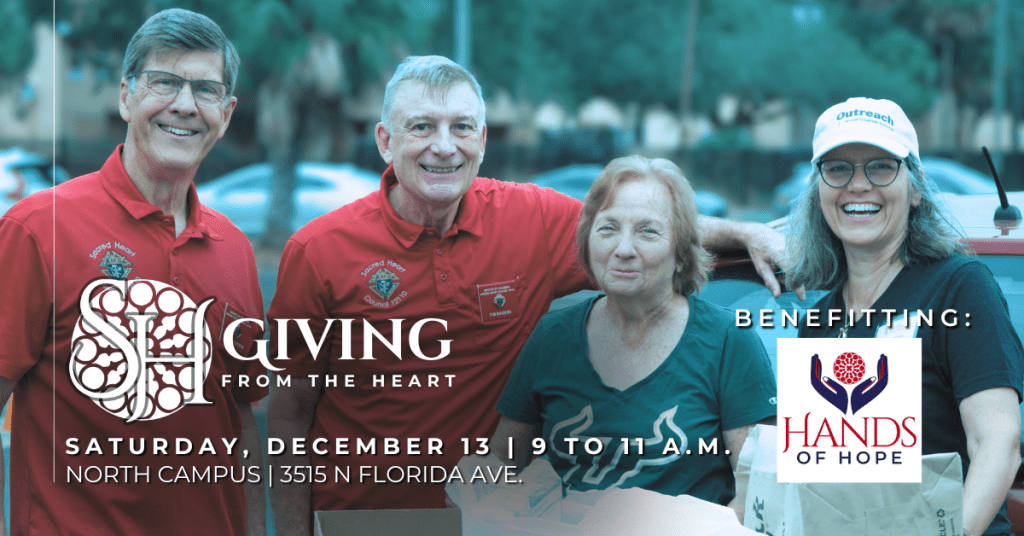
Our efforts to meet the needs of the Tampa/Hillsborough County community continue on Saturday, May 9, at the North Campus with our next Giving from the Heart drive-through donation event. Volunteers from our Women’s and Men’s Prayer Groups will be gathered from 9 to 11 a.m. to receive items assisting the Foundations of Life Pregnancy Centers, and Created Women, a local non-profit working to rehabilitate women who have suffered being trafficked.


Can’t make it to the North Campus on the day of the drive?

Click the image to access our Amazon Wishlist, and have your donation shipped directly to the parish office!


With Mother’s Day being celebrated that same weekend, the emphasis of our drive will be on aiding women, especially those facing recovery from trafficking, or those with unexpected pregnancies.

Created Women serves and empowers women affected by sex trafficking and exploitation, reclaiming their lives and restoring their value, dignity, and purpose through the redeeming love of Christ. The group turns short-term relationships into long-term rehabilitation opportunities, operating a number of decentralized recovery homes where, in a structured, trauma-informed setting, women can experience healing, restoration, and independence.

Click to View Created’s Needs List:
  • Travel Size Body Wash, Lotion, Toothpaste
  • Toothbrushes
  • Body Wipes
  • Disposable Razors
  • Sports Bras (all sizes)
  • Women’s Underwear (all sizes)
  • Women’s Pants (all sizes)
  • Socks
  • Sandals or Flip-Flops
  • Drawstring Backpacks
  • Women’s hair products

Foundations of Life is a special service offered by Catholic Charities of the Diocese of St. Petersburg, where its centers provide support to women who are facing an unplanned pregnancy. Each center offers free, confidential, and nonjudgmental assistance to women of all ages, stressing to their clients that they don’t have to face their unplanned pregnancy alone. The centers also assist with the essentials needed for early childcare through toddler ages. While the list below contains items that are always in need, the Amazon listing for this drive heavily features infant and toddler clothing (0-3 months up to 2T), which has been requested by the beneficiary as its greatest need currently.

Click to View the Foundations of Life Needs List
  • diapers (sizes 4-6 preferred)
  • formula
  • wipes
  • baby lotion
  • baby wash & shampoo
  • diaper rash creams sprays, or ointments
  • baby blankets
  • bottles
  • pacifiers
  • clothes (onesies or sizes 0-3 months, up through 2T & 3T)
  • baby caps & booties
  • used strollers carriers, & car seats
  • baby & 2nd stage foods

Additional information and needs list updates will be available on this page as they are received. As always, the church appreciates your attentiveness and generosity for these drives. As a special showing of that appreciation, the first 50 donors that arrive at the drive on May 9 will receive an Our Lady of Guadalupe multicolor auto Rosary from the Outreach Committee.

Revealing Something Deeper | Friar Reflections | Second Sunday of Easter

My Good Friends,

We often remember Thomas the Apostle by a single phrase— “Doubting Thomas”— but the Gospel reveals something far deeper and far more human. Thomas is not weak in faith; he is honest in it. In John 11:16, when Jesus sets His face toward danger, it is Thomas who speaks with striking resolve: “Let us also go, that we may die with Him.” This is not hesitation but courage. He does not fully understand what lies ahead, yet he remains with Christ. And that is where faith so often begins—not in clarity, but in fidelity. Especially as life unfolds and brings its share of uncertainty—health concerns, changing seasons, unanswered questions—faith is less about having everything explained and more about choosing to stay.

In John 14:5–6, Thomas again reveals his honesty: “Lord, we do not know where you are going. How can we know the way?” He gives voice to the confusion the others carry but do not express. And because he asks, he receives one of the clearest and most profound revelations in all of Scripture: “I am the way, and the truth, and the life.” Thomas teaches us that God is not threatened by our questions. In fact, sincere questioning—rooted not in pride but in a desire for truth—can become the very path by which deeper faith is formed. There is a quiet humility in admitting, “Lord, I do not fully see—show me,” and that humility opens the heart.

Then we come to the passage most associated with him: John 20:24–29. Thomas is absent when the Risen Christ first appears, and when the others tell him, he resists accepting their testimony: “Unless I see… I will not believe.” Yet, this is not a rejection of Christ; it is a refusal to build his life on something he has not personally encountered. And notice the response of Jesus. He does not rebuke Thomas harshly or cast him aside. Instead, He returns—specifically for him—and meets him exactly where he is: “Put your finger here… do not be unbelieving but believe.” Christ enters directly into Thomas’s doubt, not to condemn it, but to transform it.

What follows is remarkable. Thomas does not offer a cautious or partial response. He proclaims, “My Lord and my God.” This is the highest confession of faith in the Gospel of John. The one who struggled the most now sees the most clearly. This reveals a profound truth: when doubt is carried honestly into the presence of Christ, it can become the doorway to the deepest faith. The journey matters. The wrestling matters. What matters most is that we do not turn away.

Jesus then speaks words that reach beyond Thomas to every generation: “Blessed are those who have not seen and yet believe.” That is where we live. We do not place our hands into the wounds as Thomas did, but we encounter Christ in other real and sacramental ways—in Scripture, in the Eucharist, in prayer, and often in the quiet places of our own wounds, where His grace meets us.

Thomas shows us that doubt is not the opposite of faith—distance is. If we remain, if we bring our questions honestly before Christ and stay long enough to listen, He will meet us there. And in time, what begins as uncertainty can be transformed into a steady, mature faith—one capable not only of understanding, but of surrender. A faith that speaks not just with words, but with the whole of one’s life: “My Lord and my God.”

Peace and All Good,
Fr. Zack